Science news summaries — Page 4
Essential facts and source links for recent science stories.
-
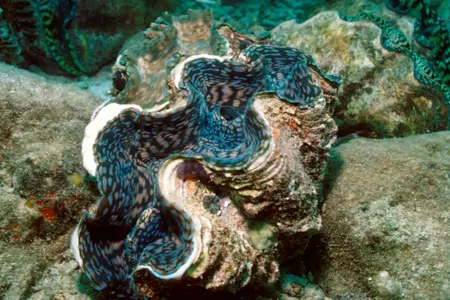
Fiji uses hatcheries and reef nurseries to rebuild giant clam stocks
Fiji is raising giant clams at the Makogai research centre and releasing juveniles into protected reef nurseries. Ministry researchers reported 100% survival and three- to fourfold growth among Tridacna maxima seeds released at Vorovoro in March 2026. -
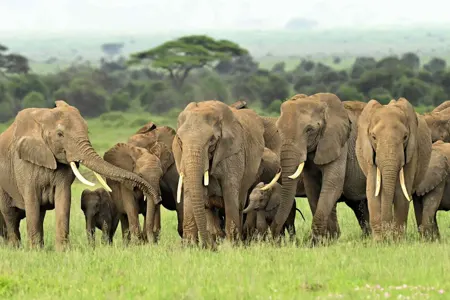
Local accounts suggest Kenyan elephants may seek plants when sick
Eight Sabaot observers told researchers sick elephants in Kenya’s Mount Elgon region may seek plants; they identified eight for therapeutic use. They also described mothers feeding calves chewed roots and leaves mixed with milk, a practice they called a kind of “immunization.” -
Army tests Fort Bragg defenses against swarms of up to 100 drones
At Fort Bragg earlier this month, the U.S. Army tested whether Apache helicopters and ground sensors could detect and stop swarms of 25 to 100 drones. Participants said a layered mix of sensors is needed; the Army did not release details of any weak points exposed. -
Nuclear subs may survive distant blasts, but not a direct hit
Nuclear submarines may survive distant nuclear blasts, but a direct hit would destroy one. Survival depends on yield, detonation location and depth; the article says crews would rise to periscope depth and set an evasive course at maximum speed, not dive deeper. -
Warm-water post from Orange County beachgoer sparks El Niño discussion
An Orange County beachgoer’s Reddit post saying the water felt unusually warm drew hundreds of comments. Users cited El Niño as a possible factor, while others mentioned Pacific storms and climate change; the article cites no ocean-temperature measurements. -
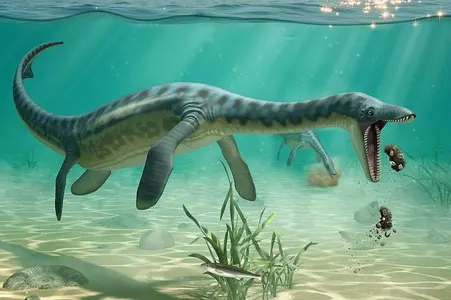
Fossilized vomit points to plesiosaurs regurgitating meals near shore
Dirk Knaust found more than 20 fossilized vomit pellets in an ancient river delta about 50 km off Norway’s coast, suggesting plesiosaurs ate shellfish in deeper water before swimming shoreward to expel hard remains. The study appeared in Geological Magazine. -
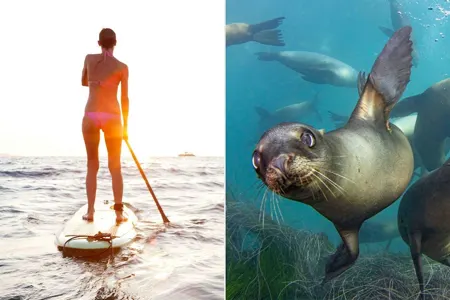
Heather Gray recounts a sea lion attack off Santa Cruz
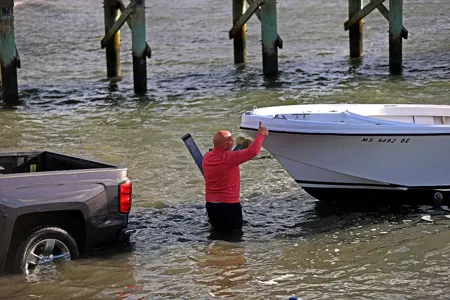
Heather Gray says a sea lion knocked her from her paddleboard and repeatedly bit her in Monterey Bay off Santa Cruz on Sept. 22. She was treated for injuries. Another aggressive encounter was reported that morning, but whether it involved the same animal is unclear. -
CVS recalls select Clear Eyes Redness Relief drops over sterility concerns
CVS is recalling select bottles of Clear Eyes Redness Relief Lubricant Eye Drops after supplier Medtech said it could not confirm their sterility. Stop using them and return the bottles to the CVS pharmacy where they were purchased; customers with a receipt can get a refund. -
Scientists say climate change is making intense nor’easters wetter and windier
A nor’easter has caused coastal flooding in parts of Virginia and North Carolina; some areas may see gusts to 50 mph, with rain potentially continuing through the weekend. Scientists say warming is making the strongest nor’easters wetter and windier, raising flood risks. -
First wasp spider recorded in Cheshire as species moves north
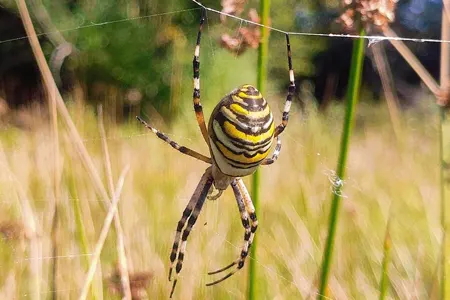
A biodiversity survey at Chester Zoo found a yellow-and-black wasp spider, confirmed by an arachnological expert as the species’ first recorded sighting in Cheshire. The zoo nicknamed it Wendy; experts say wasp spiders are moving north as temperatures rise. -
Airbus plans Sept. 29 livestream of A350F’s maiden flight
Airbus says it will stream the A350F freighter’s maiden flight on X at 4:20 a.m. EDT on Sept. 29, if weather and essential operational requirements allow. The first test aircraft, MSN700, will assess aerodynamics, handling and autopilot systems. -
RAIBO2 completes 42.195-km marathon in 4:19:52 on one charge
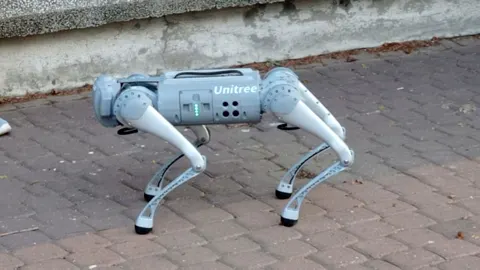
KAIST’s four-legged robot RAIBO2 completed a 42.195-km marathon in South Korea in 4:19:52 on one charge, using about 1,280 watt-hours. Researchers estimate a range of about 65 km per charge; that is a calculated figure, and actual range varies with conditions. -
Climate Week breakfast draws more than 100 to fashion circularity talks
More than 100 fashion and climate professionals gathered in New York on Thursday for the Climate Leaders Roundtable Breakfast, discussing circular business models, garment repair and sustainable materials. Its largest crowd yet was accommodated in a larger venue. -
RFK Jr. seeks evidence on possible health effects of wireless technology
HHS Secretary Robert F. Kennedy Jr. said Sept. 21 the administration launched a formal request for information on possible health effects of radiofrequency and electromagnetic-field exposure from phones, Wi-Fi, 5G and other wireless technology. -
Egypt’s New Kingdom fortress yields a 3,000-year-old horse skeleton
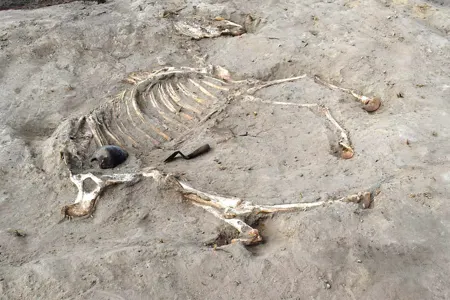
Archaeologists found a roughly 3,000-year-old horse skeleton at Egypt’s Tell el-Abqa’in fortress; preliminary studies suggest it may have been used for training, military activity or chariot pulling. They also found grain silos and wells inscribed with Ramses II’s titles. -
Oceanside project reveals mammal fossils estimated at 40–45 million years old
Paleontologist Joseph El Adli found ribs, a femur and other limb bones 12 feet underground during routine monitoring of a City of Oceanside infrastructure project; the fossils are estimated to be 40–45 million years old, but may be from either a brontothere or an amynodont. -
Energy concerns keep businesses engaged at New York Climate Week
Executives and advocates gathered at this year’s New York Climate Week to discuss AI-driven power demand, energy-market disruption and climate policy. The author argues that business concerns about energy and climate impacts sustain engagement despite US political headwinds. -
Aptar and Macquarie plan three-year study of inhaled biologic delivery
Aptar Pharma and Macquarie University will spend three years evaluating how dry-powder formulation choices affect aerosol performance in Aptar’s Orbital inhaler, aiming to generate insights for pulmonary delivery of biologic medicines. -
Marinus Link receives Australia’s first offshore Transmission and Infrastructure Licence
Australia issued its first offshore Transmission and Infrastructure Licence to 1.5GW Marinus Link, the final Commonwealth approval before full construction. The licence triggers protections against vessel anchoring and commercial damage to the cable route. -
Katalyst’s Link reenters as $30 million Swift rescue effort closes
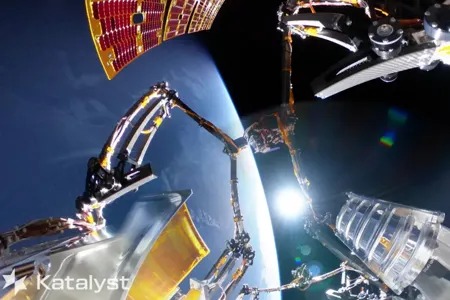
Katalyst’s Link spacecraft reentered the atmosphere Friday, less than three months after launch, ending a $30 million NASA-sponsored effort to boost the Swift Observatory into a higher orbit. The rescue was called off in August after technical failures. -
Big Bang nucleosynthesis beats the CMB on early-universe radiation
A September 2026 measurement of primordial helium-4 has made Big Bang nucleosynthesis (BBN) a more precise probe of early-universe radiation than the cosmic microwave background (CMB), helping physicists test dark-matter and hypothetical-physics models. -
Why ‘controlling for variables’ means different things across studies
Statistician Mark Louie Ramos says “control” can mean comparing people given a treatment with those who did not receive it, or adjusting observational data for factors such as age or smoking; the term alone does not establish that a finding is reliable. -
FDA panel backs Grail’s Galleri multi-cancer test as members split on effectiveness
An FDA panel recommended Grail’s Galleri test for adults 50 and older: it voted 7-2, with one abstention, that the test’s benefits outweigh its risks. Members backed safety but split 6-4 on effectiveness. Grail expects an FDA decision in the next few months. -
Premifab says its Croatian plant recycles 3 million kg of solvents a year
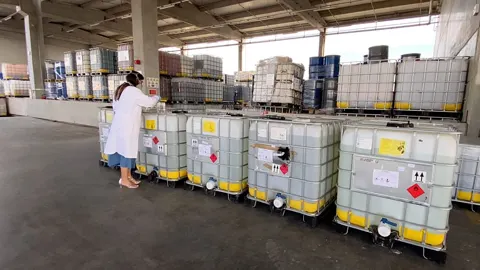
Premifab says its plant in Ivanić-Grad, Croatia, recycles about 3 million kilograms of contaminated solvents a year, distilling them for reuse in clients’ production lines. The company reports a 90% recycling rate for the material it receives. -
Workers replace corroded roof at 5,000-year-old Slieve Gullion tomb
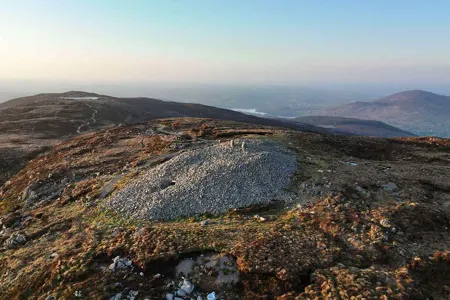
Workers are replacing the corroded roof of Northern Ireland’s 5,000-year-old Slieve Gullion Passage Tomb, which is closed during repairs. Archaeologists and engineers carry most materials up the 1,800-foot mountain each day; work is expected to finish by Dec. 21. -
French trials test robots and AI for Alzheimer’s care
At Paris’s Broca Hospital and La Septfontoise care home in Tarn-et-Garonne, French trials test robots and personalised AI for people with Alzheimer’s and other neurodegenerative conditions; uses under study include therapy and non-drug support for agitation. -
West Virginia, Kentucky and Wyoming had the highest power carbon intensity in 2024
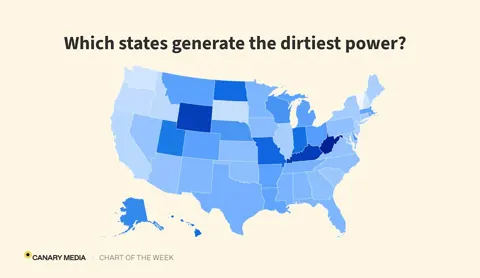
U.S. Energy Data’s compilation of federal figures shows West Virginia, Kentucky and Wyoming had the highest power-generation carbon intensity in 2024, largely because of coal use; Vermont had the lowest, with essentially all its in-state generation from renewables. -
Children’s blinking rate linked to brain activity and flexible thinking
A study of 113 children aged 3 to 6 at two preschools in Japan found that more frequent blinking was associated with greater activity in a right prefrontal region and better performance on a mental-flexibility test, even after accounting for age. -
UK dairy farmers delivered 240m fewer litres than expected after summer heat
The ECIU says UK dairy farmers delivered 240 million fewer litres than expected from May to August after extreme heat left grazing conditions poor; the shortfall equalled four days’ supply and the lost milk was valued at more than £83m.