Finance news summaries — Page 5
Essential facts and source links for recent finance stories.
-
Nike faces Oct. 1 earnings with China revenue down 12%, shares off 77% from peak
Ahead of Nike’s Oct. 1 earnings report, The Motley Fool says long-term investors could consider a small position and add only as the turnaround proves itself. Shares are 77% below their late-2021 peak; China revenue fell 12% last quarter. -
Insider Monkey favors Coinbase over Strategy in stock comparison
Insider Monkey favors Coinbase over Strategy, citing its fee-based exchange business against Strategy’s leveraged bitcoin bet. Coinbase generated about $6 billion in revenue over the past year; Strategy generated under $500 million and had close to $7 billion in debt. -
Yen’s rise casts doubt on dollar-yen uptrend as ‘death cross’ nears
Dollar-yen fell 1% Friday as the pair failed to regain its 200-day average, adding to signs its 17-month uptrend may have reversed. Treasury Secretary Scott Bessent said Trump endorsed a stronger yen; a “death cross” could form by the end of next week. -
BlackRock's recurring fees and dividend growth bolster a long-term stock case
BlackRock managed $15.3 trillion in investor assets at June’s end and reported nearly $7.1 billion in second-quarter revenue, with almost $2 billion in net income. The Motley Fool argues its recurring fees and dividend growth support a long-term investment case. -
Motley Fool columnist urges investors to weigh risk before buying stocks
A Motley Fool columnist urges investors to assess their risk tolerance before buying stocks. Bank of America has warned of a possible market correction, while JPMorgan CEO Jamie Dimon cited high valuations, geopolitical conflict, inflation and debt as risks. -
Lululemon’s P/E of 8.3 marks a 64% discount to the S&P 500
Lululemon shares were 80% below their December 2023 peak on Sept. 24, while the stock’s 8.3 P/E was 64% below the S&P 500’s. The Motley Fool presents the low multiple as a sign of Wall Street pessimism amid slowing growth and a quarterly revenue decline. -
Burry estimates $3 trillion in Big Tech AI commitments and exposures, warns of write-offs
Michael Burry estimates the five firms—Amazon, Meta, Alphabet, Microsoft and Oracle—have about $3 trillion in AI-related commitments and exposures, and says write-offs tied to their infrastructure spending could emerge around 2028 or 2029. -
Motley Fool writer makes the case for Costco after $922.77 close
Costco shares closed Friday at $922.77, but a Motley Fool column argues investors should not be deterred by the price, citing 10% revenue growth over the past year and a quarterly earnings beat even after some tariff refunds are excluded. -
Motley Fool weighs Realty Income and Philip Morris as dividend picks
The Motley Fool highlights Realty Income and Philip Morris International as dividend-stock picks, citing yields of 5.86% and 3.35%, respectively, versus the S&P 500’s 1.05% average. It favors Realty Income for income stability and sees more growth potential in Philip Morris. -
Blick: At least eight foreign banks signal interest in possible UBS tie-up
Blick reports that at least eight foreign banks signalled interest to UBS in a possible merger or combination, citing an insider. Switzerland’s upper house voted Wednesday to back tougher capital rules that UBS estimates could require about $18 billion in extra capital. -
Intel stock is up over 40% in September so far, trading at 62 times 2027 earnings estimates
Intel shares are up more than 40% in September and about 250% so far in 2026, but Motley Fool columnist Keithen Drury says the stock’s valuation—62 times estimated 2027 earnings—is hard to justify and could bring a price drop if earnings don’t catch up. -
Motley Fool backs regular investing as S&P 500 and Nasdaq hit new highs
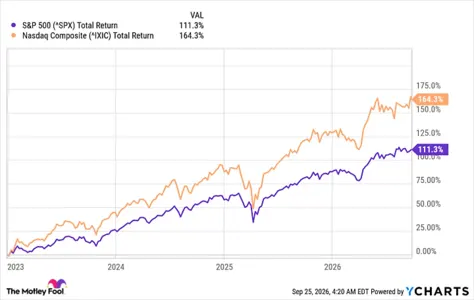
As the S&P 500 and Nasdaq hit new highs, The Motley Fool says investors should invest regularly rather than time the market. In Schwab’s 20-year study, an investor contributing $2,000 once a year ended with $170,000, versus $186,000 for a perfect timer. -
Motley Fool says Green Thumb may still look inexpensive near $8
Green Thumb Industries posted $306.7 million in second-quarter revenue, $4.9 million in GAAP net income and $29 million in operating cash flow. Motley Fool says shares near $8 may still look inexpensive, though gross margin and comparable retail sales declined. -
Court approves Spirit's $668.1 million 27-jet sale as liquidation continues
A bankruptcy court approved Spirit Airlines' $668.1 million sale of 27 aircraft; liquidation continues. Save 2026-B LLC, controlled by equipment-note holders, will take 23 planes as collateral; an FTAI affiliate will pay $100.7 million in cash for the other four. -
Lip-Bu Tan says Intel can meet only half of CPU demand as AMD gains share
Intel CEO Lip-Bu Tan said the company can meet only 50% of customer demand for CPUs. The Motley Fool says tight supply could also benefit AMD; Mercury Research puts AMD’s server-CPU share at 34.5% in Q2, up from 27.3% a year earlier. -
Realty Income's 136 dividend hikes bolster its case against 5% Treasury yields
The Motley Fool argues Realty Income may suit long-term income investors better than 10-year Treasuries yielding above 5%, citing its monthly dividend, 136 increases since 1994 and data-center and private-capital expansion as possible drivers of further growth. -
Shiller CAPE reaches 41.3, highest since dot-com era; dividend stocks cited as ballast
The Shiller CAPE ratio has reached 41.3, its highest since the dot-com era. The article cites Dividend Aristocrats’ historical resilience and the NOBL ETF’s 2% yield as portfolio ballast, but says the ETF is not guaranteed to fall less in a future correction. -
Berkshire Hathaway bought nearly $20 billion more stock than it sold in Q2
Berkshire Hathaway became a net stock buyer in Q2 after about three years: it bought $23.5 billion and sold $3.7 billion. About $17 billion went to Alphabet shares; the shift may signal Greg Abel is content with the portfolio, but one quarter is not a trend. -
Franklin Templeton’s Steve McKay warns against all-or-nothing market moves
Franklin Templeton U.S. retirement head Steve McKay says the biggest behavioral mistake in volatile markets is turning legitimate economic concerns into an all-or-nothing decision, such as moving entirely to cash, which could derail long-term retirement plans. -
Medtronic revenue rises 13.7% as its dividend yield reaches 3.2%
Medtronic reported nearly $9.8 billion in fiscal 2027 first-quarter revenue, up 13.7% year over year, and raised its full-year organic revenue growth outlook. The quarter included an extra week; shares have fallen 3% since the report, and the dividend yield is 3.2%. -
Large Roth conversions may raise taxes and Medicare premiums
Roth conversions may reduce future taxes, but large sums may bring higher tax rates and Medicare premium surcharges two years later for people on or nearing Medicare. Compare conversion tax rates with expected rates on withdrawals, and spread conversions across years. -
Meta shares climb about 13% as investors assess Muse's revenue potential
Meta's Muse AI agent drew millions of downloads in its first two weeks. The ad-free product is intended to generate revenue through a small cut of transactions; Meta shares rose about 13% over the past week as investors assessed its consumer AI potential. -
Magnificent Seven’s 31% S&P 500 share could amplify losses if AI falters
Yardeni Research data put the Magnificent Seven at 31% of the S&P 500’s value, versus just under 26% of expected earnings over the next four quarters. The article warns that high valuations and AI firms’ interdependence could weigh on the index if earnings forecasts fall short. -
Columnist argues 62% U.S. stock ownership should be higher
Gallup reported that 62% of Americans owned stocks in 2025, at the top of a 52%–62% range seen over roughly 25 years. Motley Fool's commentary says more Americans should own stocks to share in U.S. growth; it calls 100% ownership an ideal but unrealistic goal. -
Citi sees a pre-midterm stock pullback as a chance to buy
Citi expects U.S. stocks to dip before the Nov. 3 midterms but recommends holding steady and adding exposure if shares fall. It cites typical pre-midterm pullbacks and the Fed's Sept. 16 rate hike, while saying AI momentum keeps U.S. equities attractive. -
NBER study authors say 90% should wait until 70 to claim Social Security
A 2022 National Bureau of Economic Research study's authors say 90% should wait until 70 to claim Social Security, while the article's break-even math suggests an average person may claim at 62; the choice depends on longevity, health and retirement savings. -
Hyperliquid could top Bitcoin under a five-year growth scenario
The analysis assumes Bitcoin repeats its past decade’s 34% annual growth, putting its market cap above $7 trillion in five years. Only Hyperliquid among three rivals would top that level if recent gains persisted; Venice could theoretically catch up. -
David Dierking makes the case for IUSG’s large- and mid-cap mix
Motley Fool contributor David Dierking says the iShares Core S&P U.S. Growth ETF (IUSG), which tracks the S&P 900 Growth Index, merits attention for its large- and mid-cap mix. The article reports a 17.6% average annual return over 10 years and a 0.04% expense ratio.