

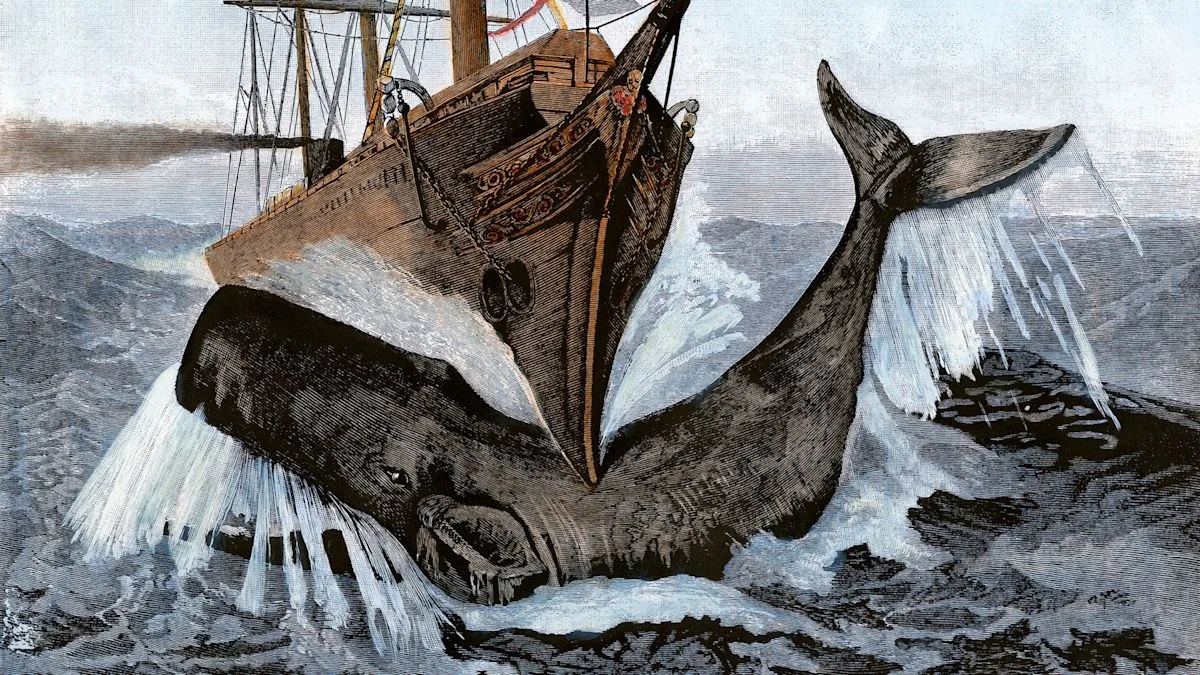
Footage of sperm whales head-butting supports a theory that they use their heads as battering rams, possibly explaining the Essex's 1820 sinking. Burslem estimates an adult strike at about 1,200 kN; the forehead organ's function remains uncertain.
Alec Burslem, an ecophysiologist, filmed several young sperm whales head-butting near the Balearic Islands and the Azores. The strongest recorded impact came from a juvenile male moving at 4.5 m/s and was estimated at 460 kN; the adult figure extrapolates to a full-grown whale at the same speed. Owen Chase, the Essex's first mate, argued its forehead was a weapon; the wreck inspired Moby-Dick.
A 2015 study suggested the organ's cushioning could let whales ram without risking damage. Michael Harrison, chief curator at the Historical Society in Nantucket, says only three whaling ships were attacked by whales; all three attackers were sperm whales, including the Ann Alexander (1851) and Kathleen (1902). Another proposed role for spermaceti involves sound: Burslem says females can judge a male's size from the combination of sounds they hear.
