

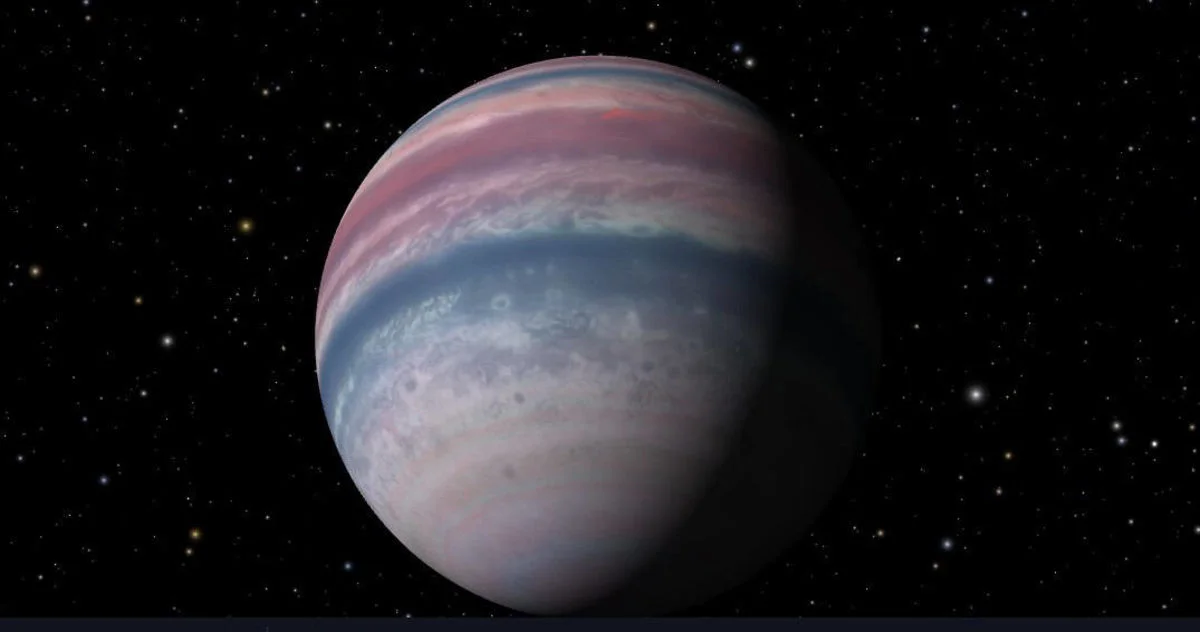
Researchers using South Africa’s MeerKAT array report repeating radio bursts traced to Beta Pictoris b, a gas giant 64 light-years away. Their non-peer-reviewed preprint says it may be the first direct radio detection from an exoplanet and links the bursts to auroras.
The team initially could not tell whether the bursts came from the planet or its star. It compared radio images with distant quasars, which serve as fixed sky markers, to attribute the signal to the planet. Researchers traced the bursts to auroral radio emission produced when charged particles strike the planet’s upper atmosphere.
The bursts yielded an estimated minimum magnetic-field strength of 1,250 gauss for Beta Pictoris b, compared with about 4.3 gauss for Jupiter and roughly 0.5 gauss for Earth. The article says such fields help shield a planet’s atmosphere from a star’s particle stream. The team expects to apply its method to other giant exoplanets; next-generation radio observatories are expected to improve sensitivity five- to sevenfold, potentially bringing them within reach.
