

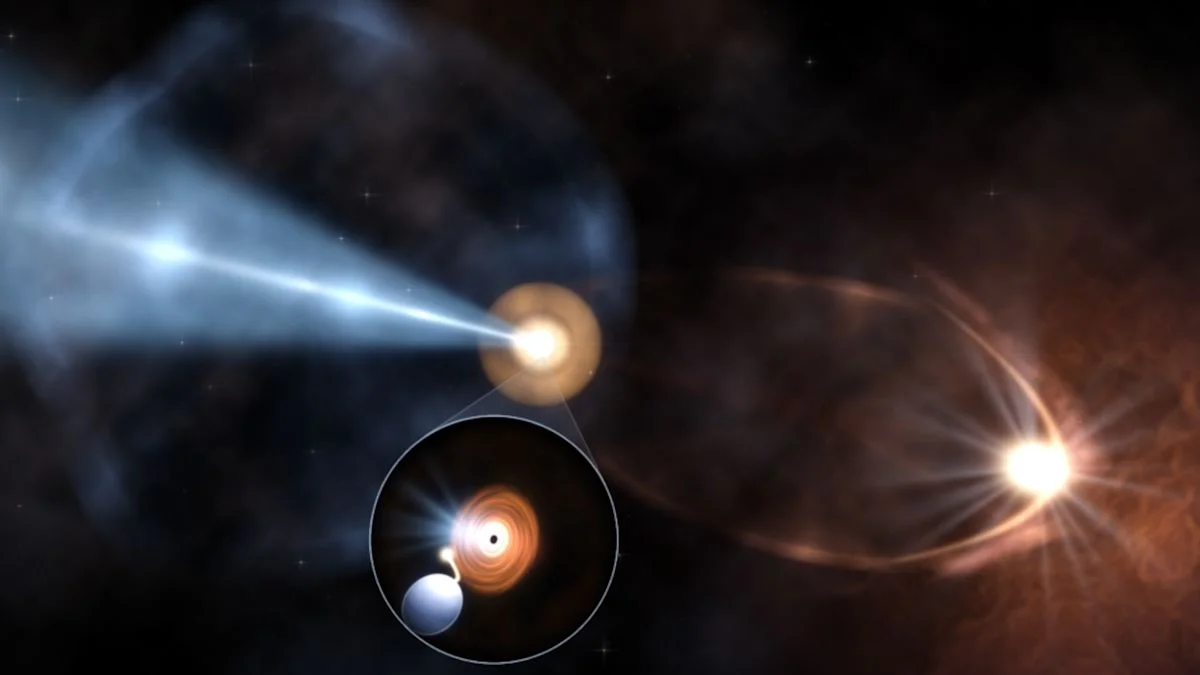
Researchers identified IRAS 18293−0941 as the Milky Way’s first known microblazar: a stellar-mass black hole drawing material from a massive companion and firing near-light-speed jets along our line of sight. The system completes an orbit every 11.4 days.
Interstellar gas and dust had hidden the system from ordinary optical images. Astronomers noticed the star’s flickering, which revealed the 11.4-day orbit; radio observations found a jet, and high-resolution European VLBI Network data confirmed it came from IRAS 18293−0941 rather than a background galaxy.
MeerKAT observations detected a 100-light-year-wide bubble where the jet directed away from Earth hits interstellar material. At a hotspot, the collision heats dust, makes hydrogen glow and accelerates particles; the region also emits gamma-ray photons, each carrying ten times the energy of particles accelerated by the Large Hadron Collider. The study is a preprint accepted for publication in Astronomy & Astrophysics.
